
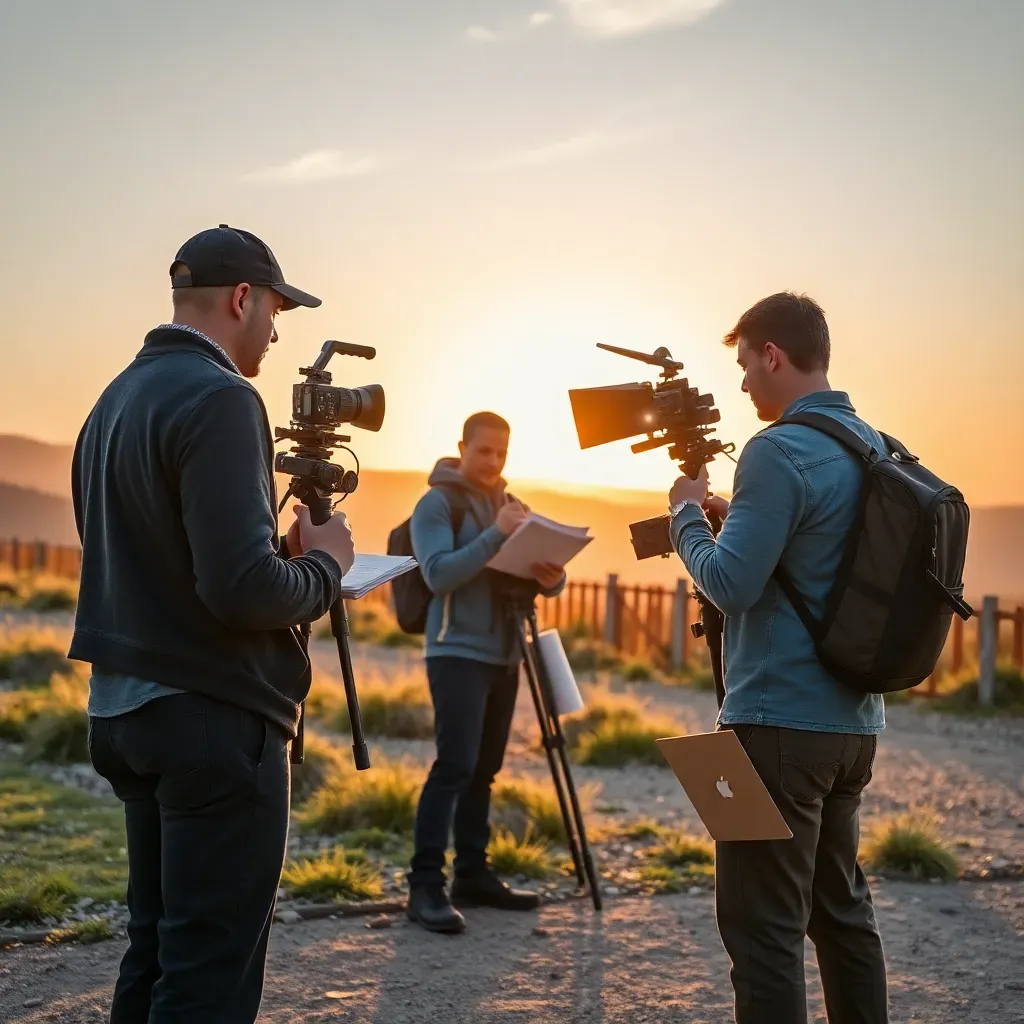
Filming in Mexico City: Permits, Studios & Production Logistics
From CFilmaCDMX permits and Estudios Churubusco stages to Centro Histórico, Polanco and Coyoacán — everything international productions need to plan a shoot in CDMX
Filming in Mexico City — filmar en ciudad de méxico — is one of the most rewarding and most set up production operations in the Americas. The city pairs Latin America's deepest crew base and most concentrated studio infrastructure with a permit landscape run by CFilmaCDMX (Comisión de Filmaciones de la Ciudad de México), spread across 16 alcaldías, with overlapping federal authorities for archaeological sites (INAH), historic buildings (INBAL) and covered federal real estate. The visual register is unmatched in the region — colonial Centro Histórico, Porfirian-era boulevards, Bauhaus-influenced Condesa, modern Polanco glass-and-steel, the bohemian intimacy of Coyoacán, and the surrealist canals of Xochimilco — and most of it sits inside one shooting day. This guide walks through what global teams actually need to know to plan a production in CDMX: where to file permits. This studios match which formats, which colonias deliver which looks, when to shoot, what the seasonal rains and altitude do to the schedule, and how security planning differs by neighbourhood. We work the CDMX film offices, stages and crew rosters each week, so the focus here is operational. Use it as a hub — each section links out to a deep-dive guide where useful.
As Fixers in Mexico, we bring local expertise to international productions filming in Mexico. Our team's deep knowledge of local regulations, crew networks, and production infrastructure ensures your project runs smoothly from pre-production through delivery.
ACT 01
Why Mexico City for Production
Industry Depth, Infrastructure, and the Looks Producers Come For
Mexico City is the operational centre of Latin American audiovisual production. The reasons global teams keep choosing it for film in Mexico City go well beyond the postcards — it is one of the few cities in the hemisphere that combines a top-tier crew base, a national funding ecosystem, and studio infrastructure built for studio-scale series and features.
- Mexico produces 200+ feature films and dozens of scripted series a year, with the bulk crewed and post-produced out of CDMX
- IMCINE, EFICINE planning, the federal SHCP, and CFilmaCDMX all sit within a single ride across the city
- Crew rosters cover Spanish, English, French, Portuguese and increasingly Mandarin and Japanese for inbound co-productions
- Centro Histórico, Polanco, Roma, Condesa, Coyoacán and Xochimilco all sit inside one shooting day on a well-planned schedule
Industry Depth and the CDMX Production Ecosystem
Mexico City film production runs on an unusually layered ecosystem. IMCINE sets national policy and oversees Eficine cinematographic review. CFilmaCDMX handles permits and location liaison at the city level, with each of the 16 alcaldías holding extra jurisdiction over their own public spaces. Major TV networks (Televisa, TV Azteca, Imagen) and global streamers (Netflix, Disney+, Amazon Prime, Apple TV+, HBO Max) all have CDMX-based commissioning and production teams. Netflix in specific has invested heavily in CDMX-based original production over the past five years. That density means union talent, post houses, gear rental, insurance, customs brokers, and legal counsel for global shoots all sit within the same urban core. For inbound shoots, this translates to fewer hand-offs and shorter pre-production cycles than in cities where the production stack is split across many regions.
Studio and Stage Infrastructure
Mexico City and the surrounding metropolitan area host the largest studio belt in Latin America. Estudios Churubusco — operating since 1945 and still one of the largest single-site studio complexes in the region — anchors the south of the city. Estudios Argos handles much of the country's streaming and series volume. The Televisa San Ángel campus continues to operate as one of the busiest broadcast and drama production facilities in the hemisphere. Add Baja Studios (a six-hour drive or short charter from CDMX) for water tank and large-format work. The city sits at the centre of more than 50,000 m² of soundstage capacity within the Mexican market. Backlot space, motion-control rigs, virtual production volumes, and full-service post houses are all ready without leaving the metropolitan footprint.
Crew, Talent, and Language Coverage
CDMX crews are deep in each department. Cinematographers, gaffers, key grips, sound mixers, art directors, costume designers, hair and makeup, VFX supervisors, and stunt coordinators are all ready at the day rates set by STIC (Sindicato de Trabajadores de la Industria Cinematográfica) and STPC (Sindicato de Trabajadores de la Producción Cinematográfica). English fluency is standard at HOD level and increasingly common down to assistant grades. CDMX is the easiest Mexican city to source bilingual second units for shoots running in Portuguese, French, Italian, German, Mandarin or Japanese. Talent agencies in Polanco, Roma and Condesa represent the bulk of feature, series and commercial talent, and casting directors here handle SAG, ANDA and global co-productions negotiations as a matter of course.
Signature Visual Looks
The visual reasons producers come to CDMX are well-known: Centro Histórico's Spanish colonial squares for period and modern work, Reforma's Porfirian boulevards for grand-scale setting up shots, Roma and Condesa for early-twentieth-century facades and tree-lined streets (Cuarón's Roma made the look worldwide legible), Polanco for modern luxury and corporate registers, Coyoacán for bohemian and intimate drama, Xochimilco's canals and trajineras for surreal and aquatic sequences, and the Templo Mayor and Palacio Nacional perimeter for direct pre-Columbian and colonial-era beats. Each of these is briefed in detail below, with guidance on how shoot in Mexico City workflows actually clear them.
ACT 02
Filming Permits in Mexico City
CFilmaCDMX, the 16 Alcaldías, INAH and the Permit Landscape
Mexico City filming permits are set up by CFilmaCDMX (the city film commission) but routinely touch one or more of the 16 alcaldías, the federal cultural authorities for archaeological and historic-building access, and the federal Secretaría de Seguridad Ciudadana for traffic and public-order planning. This section gives you the operational summary — the deep-dive on records, fees and edge cases lives in our dedicated permits guide.
- CFilmaCDMX is the primary entry point for street, park and public-space filming across the Federal District
- Each of the 16 alcaldías (Cuauhtémoc, Miguel Hidalgo, Coyoacán, Tlalpan, Xochimilco and others) holds extra jurisdiction over their own public spaces and triggers separate forms
- INAH (Instituto Nacional de Antropología e Historia) governs archaeological sites and pre-Columbian monuments — Templo Mayor, the Tenochtitlán perimeter, satellite sites
- INBAL (Instituto Nacional de Bellas Artes y Literatura) governs federally covered twentieth-century historic buildings — Palacio de Bellas Artes, certain museums, federal monuments
- Metro CDMX (STC) and the federal airport authority hold their own permitting processes for transit and aviation-adjacent shoots
CFilmaCDMX as the Primary Coordinator
CFilmaCDMX is the single most important entry point for most public-domain filming in Mexico City. They handle requests for streets, plazas, parks, city-owned buildings and the wider public space across the Federal District. Standard street shoots with a small footprint (handheld, no truck, no crew base) are mostly clearable in two to three weeks. Larger setups — full lighting packages, power packs, picture cars, base camp — extend the lead time to four to six weeks and trigger planning with the relevant alcaldía and the Secretaría de Seguridad Ciudadana. CFilmaCDMX reviews shoot synopses, neighbourhood impact, security plans and the production's local representative before issuing the permiso de filmación. They also set up the bombero (fire marshal) and Cruz Roja paramedic presence needed on most permits.
The 16 Alcaldías and Why They Matter
Mexico City is divided into 16 alcaldías, each with a mayor, a budget and a degree of operational autonomy that surprises producers used to single-jurisdiction permitting. A shoot day that starts in Centro Histórico (Cuauhtémoc), moves to Polanco (Miguel Hidalgo) and ends in Coyoacán has touched three alcaldías and three sets of forms — even when CFilmaCDMX handles the umbrella permit. Coyoacán, Tlalpan and Xochimilco in the south, Miguel Hidalgo and Cuauhtémoc in the centre, and Iztapalapa and Gustavo A. Madero in the east all run their own film offices plus the citywide commission. A local fixer who keeps relationships across all 16 is meaningfully faster than a producer trying to handle the geography from outside.
INAH, INBAL and Heritage Sites
Filming inside or in the immediate perimeter of major heritage and archaeological sites. Templo Mayor, the Zócalo perimeter facing the Cathedral and Palacio Nacional, Palacio de Bellas Artes, the Teotihuacán complex an hour outside the city — is ruled by INAH or INBAL based on type, not CFilmaCDMX. INAH handles pre-Columbian and archaeological sites. INBAL handles twentieth-century historic buildings of artistic weight. Lead times here run six to twelve weeks, location fees are major, approvals are conditional on shot lists, gear lists and at times script review, and drones over INAH sites are heavily off-limits. For a complete walkthrough of permit types, fees, records and rejection-recovery tactics, see our Mexico City permit deep-dive at /blog/filming-permit-city-guide/.
ACT 03
Studios in Mexico City
Estudios Churubusco, Estudios Argos, Televisa San Ángel and Baja Studios
CDMX studios sit across the city, with the largest concentration in the south around Coyoacán and Tlalpan and extra capacity in San Ángel. The lineup below is a working summary — the full sourcing guide with stage dimensions, ceiling heights, water tank specs and virtual production volumes lives in our dedicated studios article.
- Estudios Churubusco (Coyoacán) — operational since 1945, one of the oldest and largest studio complexes in Latin America
- Estudios Argos (Tlalpan) — high-volume series and streaming production base, used by Netflix, Amazon and HBO Max for Spanish-language originals
- Televisa San Ángel — long-standing broadcast and drama campus with many stages and on-site production support
- Baja Studios (Rosarito, Baja California) — purpose-built for Titanic, holds the largest film water tank in the Western Hemisphere, used for Master and Commander, Pearl Harbor and many later water-heavy global features
Estudios Churubusco — Coyoacán
Estudios Churubusco in Coyoacán is the historical anchor of Mexican cinema and stays one of the largest single-site film studios in Latin America. Many soundstages totalling more than 8,000 m² of stage space, a backlot, post-prod facilities, and on-site infrastructure for major features and series sit on the campus. It has hosted shoots from Roma to Spectre's opening sequence and continuing global series for the major streaming sites. For inbound shoots running long-form drama with central CDMX bases, Churubusco stays the default first call when stage-to-location turnarounds need to stay inside an hour and the production wants to be inside the alcaldía permit ecosystem from day one.
Estudios Argos and the Streaming Series Belt
Estudios Argos in Tlalpan grew from a single Mexican production house into one of the most active scripted-series facilities in the Spanish-speaking world. Netflix's Spanish-language originals (Narcos: Mexico, La Casa de las Flores, Club de Cuervos), Amazon's regional series and several HBO Max and Apple TV+ projects have based their stages here. The campus gives many stages of differing sizes, art-department workshops, prop houses and crew availability optimised for episodic production. For inbound series planning a six-to-ten-episode Mexico-based shoot, Argos is mostly the first conversation alongside Churubusco.
Televisa San Ángel and Broadcast Capacity
Televisa San Ángel stays one of the largest television production campuses in the Americas, with many operational stages, dressing facilities, scenic shops and on-site infrastructure built around non-stop broadcast operations. While Televisa's primary use of the campus is its own programming, third-party rentals are ready and the depth of the on-site tech crew, art department and post infrastructure makes it a credible option for global series and high-end commercials. The location in southern CDMX puts it within easy reach of Coyoacán, San Ángel itself and the southern colonias.
Baja Studios and the Water Tank Option
Baja Studios in Rosarito, six hours' drive south of San Diego or a short charter flight from CDMX, is the regional answer for water-heavy shoots. The complex was built by Fox for Titanic, holds the largest exterior film water tank in the Western Hemisphere (a 17-million-gallon tank with a horizon merge), and has later hosted Master and Commander, Pearl Harbor, In the Heart of the Sea and many global features that needed open-water scale without losing studio control. For shoots that need the water skill and the proximity to the US, Baja is often staged in conjunction with CDMX-based interiors and post. For full stage matrices, daily rates, and the stages best suited to virtual production and LED-volume work, see our CDMX studios sourcing deep-dive at /blog/production-studios-city/.
ACT 04
Locations in Mexico City
The Visual Categories That Bring Producers to CDMX
Mexico City's strength as a location city is the variety of distinct visual registers within a small radius. The types below cover most of what global shoots request — for the operational scout files (best times of day, light, foot traffic, permit difficulty), see our CDMX location scouting guide.
- Centro Histórico — Spanish colonial squares, the Zócalo, the Templo Mayor perimeter, colonial-era streets
- Reforma and the Porfirian boulevards — Paseo de la Reforma, Ángel de la Independencia, grand civic axes
- Roma and Condesa — early-twentieth-century facades, tree-lined streets, art deco interiors (the Roma look)
- Polanco — modern luxury, embassy row, glass-and-steel corporate blocks
- Coyoacán — colonial cobbles, bohemian plazas, the Frida Kahlo and Trotsky house museums
- Xochimilco — the canals, trajineras, surreal floating gardens, weekend party atmosphere
- San Ángel — colonial weekend market, Diego Rivera and Frida Kahlo studio house
- Tlatelolco and the Plaza de las Tres Culturas — pre-Columbian, colonial and modern in one frame
- Industrial and infrastructure — the Periférico, the AICM and AIFA airports, the rail corridors of the east
Centro Histórico, Reforma and the Civic Spine
The Centro Histórico — declared a UNESCO World Heritage Site in 1987 — concentrates the Spanish colonial register that defines Mexico City's most worldwide recognisable look. The Zócalo (Plaza de la Constitución) anchors a perimeter that has the Catedral Metropolitana, the Palacio Nacional, the Templo Mayor and the colonial-era streets that radiate outward through Cuauhtémoc. Permits here run through CFilmaCDMX with the alcaldía and, for the Templo Mayor and the Cathedral perimeter, through INAH and INBAL respectively. Just west, the Porfirian-era Paseo de la Reforma — modelled on Vienna's Ringstraße and Paris's grand boulevards — gives the city its grandest civic axis, anchored by the Ángel de la Independencia, the Diana Cazadora and the Estela de Luz. Reforma is the first place producers go for grand-scale setting up shots and political-thriller geometry.
Roma, Condesa and the Bauhaus Belt
The Roma and Condesa colonias deliver the early-twentieth-century register that Cuarón's Roma made worldwide legible. Roma Norte's Plaza Río de Janeiro, Calle Orizaba and the surrounding streets give producers tree-lined boulevards, art nouveau and art deco facades, courtyard apartments and walkable cafe culture. Condesa adds a Bauhaus and Mexican modernist layer through the Parque México and Parque España, with curved streets that read distinctly in new ways from CDMX's more typical grid. Both colonias are mid-density residential. This means early-morning shoot windows (5–9 AM) and weekend logistics are mostly the operational answer for street work involving lockups.
Coyoacán, San Ángel and the Bohemian South
Coyoacán's cobbled plazas. Plaza Hidalgo and the Jardín Centenario — and the surrounding colonial streets give producers an intimate, romantic register that contrasts with the civic scale of Centro Histórico. The Casa Azul (Frida Kahlo Museum), the Trotsky House, the colonial parish church and the weekend artisan market all sit within walking distance. San Ángel further south gives a similar register with quieter foot traffic and access to the Diego Rivera and Frida Kahlo studio-house museum. Both areas are alcaldía Coyoacán and Álvaro Obregón respectively. Both run distinct permit workflows that gain from a fixer with set up relationships in those alcaldías.
Polanco, the Modern Skyline and Xochimilco
For the modern register, Polanco delivers modern luxury, embassy row, the Museo Soumaya's distinctive aluminium-clad form, the Auditorio Nacional, and the corporate glass-and-steel blocks along Avenida Presidente Masaryk. The Reforma corridor's high-rise cluster (Torre Reforma, Torre BBVA, Torre Mayor) gives a comparable modern register with civic-axis geometry. At the other end of the city's visual range, Xochimilco's canals. UNESCO-listed — give a surreal aquatic register with the trajineras (flat-bottom boats decorated in primary colours), floating gardens (chinampas) and a weekend party atmosphere that has anchored many global shoots over the years. For the full taxonomy with permit difficulty ratings and shoot-window guidance, see /blog/commercial-shoot-locations-city/ and our /services/pre-production/location-scouting-services/ page.
ACT 05
Seasonal Considerations for Filming in Mexico City
The Rainy Season, Altitude, Air Quality and Festival Blackouts
When you shoot in Mexico City matters almost as much as where. The city has clear seasonal windows driven by the rainy season (May–October), the dry season (November–April), the altitude (2,240 metres / 7,350 feet above sea level) and a calendar of religious, civic and cultural events that compress availability. Plan against this calendar from the first scout.
- Best operational months: late November through early May (dry season, clearest skies, lowest rain risk)
- Rainy season runs May through October, with peak afternoon thunderstorms June–September — schedule exteriors before 14:00
- Altitude (2,240m) affects crew stamina, gear performance and on-screen physical performance — plan acclimation days for inbound talent
- Major event blackouts: Día de Muertos (late October–early November), Independence Day Grito (15–16 September), Semana Santa, the Mexico City Marathon
Rainy Season, Dry Season and the Production Calendar
Mexico City's climate is structured around two clear seasons. The dry season runs from November through April, with stable weather, low humidity, clean air and the longest practical shoot days the year gives. December and January days run 11 hours of usable daylight. The rainy season runs May through October, with the peak afternoon thunderstorm window June–September: it is common to lose two to three afternoon hours each day to rain in this period, and night shoots can be disrupted with little warning. The operational answer for rainy-season exteriors is to schedule them before 14:00 and to keep an interior cover-set option live for each afternoon. Mornings stay reliably dry even at peak monsoon. Late November and December give the cleanest light quality of the year, although they coincide with the Día de Muertos and end-of-year holiday windows.
Altitude, Air Quality and Crew Stamina
CDMX sits at 2,240 metres / 7,350 feet above sea level — the same elevation as Aspen, Colorado. The altitude affects gear (drone propeller efficiency drops, power packs run hotter, hot-air balloon and aerial work has to be re-modelled) and people (inbound crew and talent fatigue faster on the first three to five days, and intense physical action sequences need extra safety margin). Plan a 24–48 hour acclimation buffer for inbound HODs and talent before any high-output shoot day. Stay aware of dehydration — the dry climate compounds altitude effects. Air quality is mostly good November through May but can deteriorate in the spring (March–April) and during late-season biomass burning around the Valley of Mexico. This is worth checking against any outdoor commercial or fashion shoot where smog haze would compromise the look.
Festival, Religious and Civic Blackouts
Several windows in the CDMX calendar effectively remove parts of the city from the production pipeline. Día de Muertos (late October–early November) saturates Centro Histórico, San Andrés Mixquic and the major panteones with cultural programming and tourist density — the Reforma parade alone closes the avenue. Independence Day (15–16 September) closes the entire Zócalo and Reforma perimeter for the Grito ceremony and the military parade. Semana Santa (Holy Week, March–April) is a national holiday that empties the city as residents leave and reduces crew availability. The Mexico City Marathon (mostly late August), the Formula 1 Mexican Grand Prix (late October–early November) and major political events (presidential addresses, state visits) trigger short-notice closures of central districts that no permit can override.
ACT 06
Crew Availability, Costs and Security Planning
Lead Times, Day Rates, Cost Base and Neighbourhood Security
Mexico City gives Latin America's deepest crew availability and one of the most competitive cost bases in the hemisphere. Plan crew bookings against the city's calendar, price the cost-base advantage into the budget from day one, and build security planning around the specific neighbourhoods on the schedule.
- DOPs, key grips, gaffers and sound mixers: 3–6 weeks lead time for top tier, 1–2 weeks for mid-tier
- Production designers and costume designers: 4–8 weeks for prep-heavy shoots
- Stunt coordinators, SFX supervisors and underwater units: 4–8 weeks for full-scale work
- Cost base 30–60% below US studio cities for equivalent below-the-line specs
- Security planning is colonia-specific — Polanco, Roma, Condesa, Coyoacán and Centro tourist core differ materially from the eastern and northern peripheries
Lead Times and Day Rates for CDMX Crew
For a typical inbound feature or six-episode series shooting in CDMX, plan six weeks minimum from script lock to first day of principal photography just for crew booking. Director of photography, production designer and 1st AD are mostly the binding constraints — top-tier CDMX talent works across many competing shoots year-round and overlaps with the heavy Netflix and HBO Max episodic slate. Mid-tier department heads and the bulk of crew are mostly ready with one to two weeks notice outside the high-season scripted-series windows. Commercials run on tighter schedules — typical lead time for a five-day CDMX commercial is one to two weeks for crew, at times less if the agency has standing relationships. Day rates run roughly USD 200–400 for camera assistants and electricians, USD 350–600 for gaffers and key grips, USD 600–1,200 for directors of photography, and USD 1,000–2,000 for production designers — all under STIC and STPC collective agreements with social security (IMSS) and ISR retentions on top. The cost base is materially lower than London, Paris or New York and broadly competitive with other Latin American capitals.
Security Planning by Neighbourhood
Mexico City's security picture is more nuanced than global media coverage hints. Security planning has to be neighbourhood-specific rather than blanket-citywide. The colonias where global shoots mostly work. Polanco, Roma, Condesa, Coyoacán, San Ángel, Centro Histórico's tourist core, Reforma — are well-policed, have low violent-crime rates, and are in practice similar to comparable districts in any large Latin American or southern European capital. Standard production protocols (car security, gear tracking on base camp, an on-site security coordinator) are enough for most shoots in these areas. The eastern and northern peripheral alcaldías (Iztapalapa, Gustavo A. Madero, parts of Tlalpan and Xochimilco beyond the canals) need more deliberate planning — extra armed escort for high-value gear, daylight-only schedules in some specific zones, and a security coordinator with today's local intelligence rather than generic protocols. A CDMX-based fixer who can read the picture week by week (and who can advise on which Xochimilco trajinera operators. This Centro vendor blocks and which late-night Roma shoots need extra planning) is the cheapest insurance ready. CFilmaCDMX permits routinely have a Secretaría de Seguridad Ciudadana presence on the schedule. That planning is itself a major security asset on the day.
Cost Base, Eficine and the Wider Financial Picture
CDMX's underlying cost base is the strongest single financial argument for shooting here. An USD 3 million production mostly runs 30–60% below the same production shot in Los Angeles or New York for equivalent below-the-line specs, before any incentive is applied. Add the realistic Eficine slice on top (where the project qualifies as a Mexican co-production), and the gap widens further. Eficine can return up to MXN 17.5 million per project as a fiscal credit against Mexican corporate income tax — accessed through a Mexican producer or investor firm under co-production logic, with realised value mostly landing in the USD 410K–620K range on an USD 3M shoot after structuring. The full mechanics, application timeline and records needs are covered in our /blog/film-tax-incentives-guide/ — and our team can walk you through whether your production qualifies for Eficine before you commit to a CDMX production base. To start a CDMX production conversation, contact us at /contact/ with your script status, shoot window and budget envelope.
ACT 07
Common Questions
How long do filming permits take in Mexico City?
CFilmaCDMX typically processes standard street filming permits in three to four weeks. Larger setups with lighting, generators, picture vehicles or base camp extend to four to six weeks because they require coordination with the Secretaría de Seguridad Ciudadana and the relevant alcaldía. Major road closures (Paseo de la Reforma, the Periférico, the Centro Histórico perimeter for parades) take eight to twelve weeks. INAH-controlled archaeological sites — Templo Mayor, the Tenochtitlán perimeter, Teotihuacán an hour outside the city — run six to twelve weeks and may require script review. INBAL-controlled historic buildings (Palacio de Bellas Artes, certain federal museums) follow similar lead times. Always build buffer for Día de Muertos, Independence Day weekend, Semana Santa and the Formula 1 Mexican Grand Prix when nothing moves quickly.
Can I shoot in public spaces in Mexico City?
Yes, with a permiso de filmación from CFilmaCDMX and the relevant alcaldía. Streets, plazas, parks, public squares and city-owned buildings are all accessible to filming with the right permit, insurance certificate (typically MXN 30–60 million / USD 1.5–3 million public liability), and a local production representative. Anything affecting road traffic, requiring crowd control or involving stunts and pyrotechnics also needs Secretaría de Seguridad Ciudadana clearance and frequently requires bombero (fire marshal) and Cruz Roja paramedic presence on set. Handheld shoots with a small crew and no equipment footprint can sometimes proceed under simplified declarations — confirm with your fixer before relying on that route, particularly in Centro Histórico where heritage perimeters complicate even small footprints.
What is the best season to shoot in Mexico City?
Late November through early May is the reliable window. The dry season delivers stable weather, low rain risk, the longest usable daylight and the cleanest light quality of the year. Avoid the peak rainy-season afternoons June through September (afternoon thunderstorms cost two to three hours of exterior shooting most days), Día de Muertos in late October and early November (Centro Histórico saturated with cultural programming and tourist density), the Independence Day weekend 15–16 September (Reforma and the Zócalo closed for the Grito and military parade), Semana Santa in March–April (national holiday, reduced crew availability) and the Formula 1 weekend in late October–early November (Polanco and the Autódromo perimeter heavily impacted). Morning shoot windows are reliable across all seasons because the rainy-season storms peak in the afternoon.
Do I need a fixer to shoot in Mexico City?
For practical purposes, yes. CFilmaCDMX, the alcaldías, INAH and INBAL all require a local production representative who can respond to on-set issues, file Spanish-language paperwork, and act as the named contact on the permiso de filmación. International productions also need Mexican payroll for any local crew (with IMSS social security and ISR retentions properly handled), Mexican insurance recognised by the permit office, customs handling for equipment imports under temporary admission, and CFDI-compliant invoicing for any spend that needs to support an Eficine application. A CDMX-based fixer or local production service company holds these relationships across the 16 alcaldías and the federal authorities, and is generally faster, cheaper and lower-risk than building them from scratch for a single production.
What are typical day rates for Mexico City crew?
CDMX crew day rates run roughly USD 200–400 for camera assistants and electricians, USD 350–600 for gaffers and key grips, USD 600–1,200 for directors of photography, and USD 1,000–2,000 for production designers — all under STIC and STPC collective agreements. Add IMSS social security contributions and ISR retentions on every Mexican payroll line. Equipment rental, location fees and base-camp logistics are typically 30–60% below US studio cities for equivalent specifications, and broadly competitive with other Latin American capitals. The Eficine fiscal credit (up to MXN 17.5M per qualifying co-production) can offset a meaningful slice of total CDMX spend for projects structured through a Mexican producer or investor company — see /blog/film-tax-incentives-guide/ for the full mechanics.
Ready to Roll
Planning a Production in Mexico City?
Whether you are scouting Centro Histórico colonial squares for a feature, locking an Estudios Churubusco stage for a streaming series, or scheduling a five-day commercial around Día de Muertos and the Mexican Grand Prix, our CDMX team has the permits, crews, alcaldía relationships and studio access ready to go. Filmar en ciudad de méxico is what we do every week — and we run the operational side so directors and producers can focus on the work. Contact Fixers in Mexico to discuss your next project.