
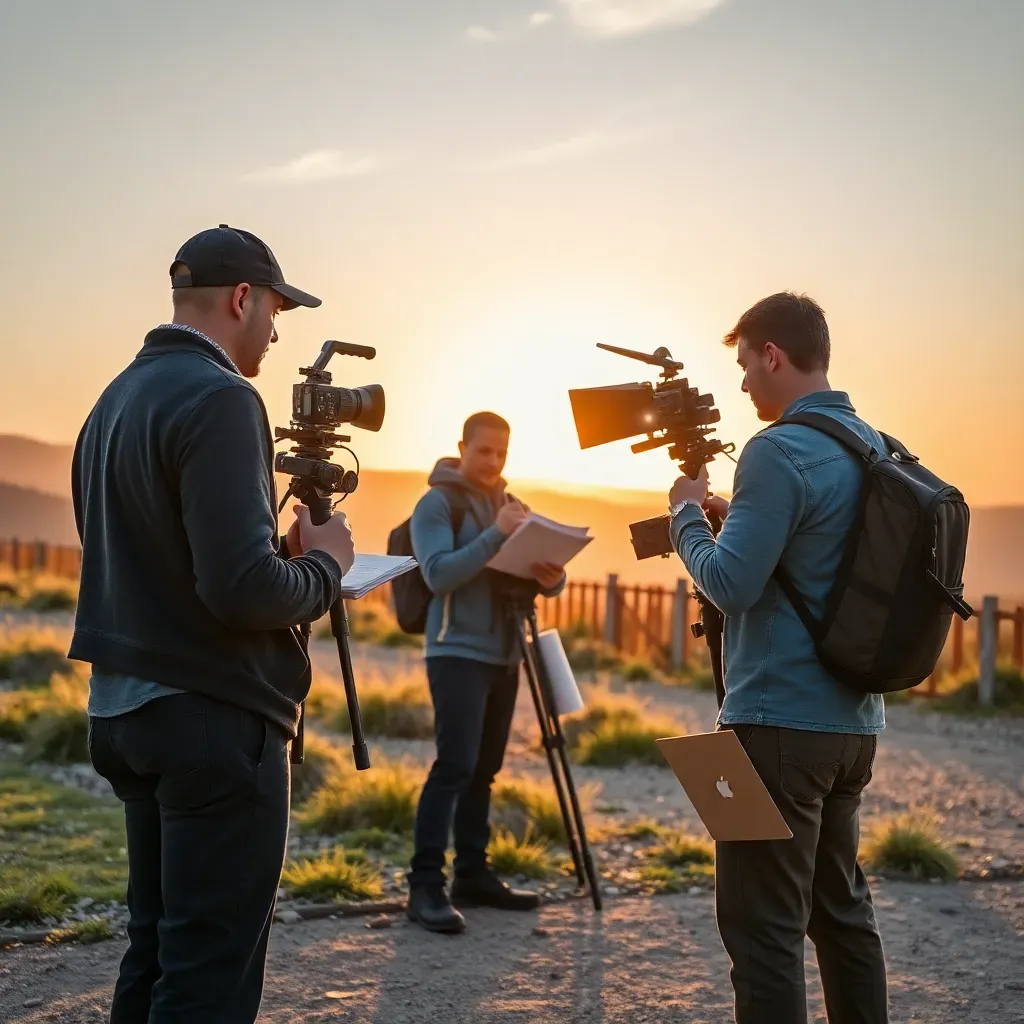
What Is a Film Fixer? The Complete Guide to Production Fixers
How international productions navigate Mexico's filming landscape — from INAH archaeological permits and Eficine tax incentives to cross-border logistics with Los Angeles and assembling Spanish-speaking crews across thirty-two states
A film fixer is the local production pro who turns a foreign crew's ambitious schedule into reality. In Mexico — a country where ancient pyramids sit an hour's drive from top-spec soundstages, where Baja California doubles as a Hollywood backlot and Oaxacan villages give locations found nowhere else on earth — that translation between vision and logistics is anything but straightforward. The role grew out of journalism, where correspondents depended on local contacts to open doors and handle unfamiliar ground. The film industry adopted the concept and pushed it far beyond its origins. Today a production fixer in Mexico may set up INAH permits at a covered archaeological zone in the morning, liaise with CFilmaCDMX for a street closure in Condesa by noon, and brief an incoming camera team on Eficine forms before the day ends. Whether you call them a fixer, a local production partner, or a shoot service firm, the function is the same: they bridge the gap between a global shoots's creative ambitions and the realities of shooting in a country with its own rules, language, pace, and culture. This guide explains what fixers do, when hiring one becomes key, how the role differs from a line producer or coordinator, what drives costs, and what to look for when choosing a partner for your shoot in Mexico.
As Fixers in Mexico, we bring local expertise to international productions filming in Mexico. Our team's deep knowledge of local regulations, crew networks, and production infrastructure ensures your project runs smoothly from pre-production through delivery.
ACT 01
What Is a Fixer?
The Local Expert Behind Every Successful International Shoot
In the film industry, a fixer is a locally rooted production pro who manages the logistics, relationships, and regulatory needs that global crews cannot handle on their own. The word surfaces across journalism, politics, and real estate. But within production it refers specifically to someone who combines deep knowledge of an area — its permit offices, its crews, its gear houses, its unwritten rules — with the production experience needed to deploy that knowledge under pressure and on deadline.
- Fixers keep working relationships with government film offices, city authorities, and community leaders across their area
- They act as the production's official local representative — signing permit applications, negotiating with vendors, and standing as the point of contact for any authority that needs to reach the shoot
- Most fixers in Mexico are fluent in both Spanish and English. Many handle indigenous languages encountered on location in Oaxaca, Chiapas, or the Yucatán
- The role spans a range from a single freelance coordinator to a full [shoot service firm](/services/) with departmental staff and permanent infrastructure
How the Term Entered Film Production
Foreign correspondents coined the term for the local contact who could arrange interviews, translate conversations, and cut through bureaucratic obstacles in unfamiliar countries. When global film production accelerated through the 1990s — and Mexico became a magnet for Hollywood features chasing its landscapes, studio capacity, and proximity to Los Angeles — production firms found they needed the same kind of ground-level expertise, but at a scale no journalist ever needed. A reporter's fixer might arrange a single meeting with a government official. A fixer working on a global feature sets up months of complex logistics across many states, manages dozens of local crew members, and navigates permit needs that change based on whether a location is federal, state, or city jurisdiction.
Solo Fixer vs Production Service Company
The distinction matters more than the labels suggest. A solo fixer is mostly a freelancer — a skilled person who gives planning, problem-solving, and local knowledge for smaller shoots. A shoot service firm is a registered business that delivers full support: crew payroll, gear rental, financial accounting, insurance, customs clearance, and full production management under one roof. In Mexico, many of the most respected fixers started as solo operators and built firms around themselves as the market grew. When a production searches for a fixer in Mexico City, Guadalajara, or the Baja Peninsula, they frequently need the infrastructure of a shoot service firm rather than a single point of contact, above all when the shoot spans many states and involves Eficine or state-level incentive applications.
ACT 02
What Does a Fixer Do?
The Full Scope of a Production Fixer's Work in Mexico
The day-to-day responsibilities of a fixer stretch across the entire lifecycle of a production, from the first recce trip to the final gear return. In Mexico, those responsibilities carry extra layers: federal and state permit systems that do not always align, INAH oversight at any site with historical or archaeological weight, customs procedures for gear entering from the United States, and a production culture shaped by one of Latin America's strongest domestic film industries.
- [Filming permits](/services/pre-production/film-permit-acquisition/) — identifying which authority governs each location, preparing applications for CFilmaCDMX, state commissions, or INAH, and shepherding approvals through timelines that differ a lot by jurisdiction
- [Crew sourcing](/services/film-crew/) — tapping Mexico's deep talent pool across all departments, from camera and grip teams trained at Estudios Churubusco to specialized marine crew at Baja Studios
- Gear — arranging rental from set up local vendors in Mexico City and Guadalajara, setting up short-term import permits and customs clearance for gear crossing the US border
- [Location scouting](/services/pre-production/location-scouting-services/) — matching creative briefs against Mexico's extraordinary range of environments while factoring in permit feasibility, security assessments, and logistical access
- Government and community liaison — representing the production to federal, state, and city authorities, and managing relationships with ejidos, indigenous communities, and property owners whose cooperation sets location access
- Translation and cultural mediation — converting not just language but context, expectations, and working norms between global crews and Mexican partners
- Transport and lodging — organizing car fleets, cross-border travel logistics, hotel blocks in cities where production activity can strain ready rooms, and daily crew movement across sprawling locations
- Budget management — building accurate local budgets in MXN, managing petty cash, processing invoices from Mexican vendors, and preventing cost overruns that stem from unfamiliarity with local pricing structures
- Emergency problem-solving — responding to the unexpected with local knowledge that no amount of pre-production research can replace
Pre-Production: Building the Foundation
Before a single frame is shot, the fixer sets up the operational groundwork. In Mexico, this starts with location research that accounts for far more than visual appeal — a colonial-era church in Oaxaca may be visually perfect but needs INAH approval with lead times measured in months, while a street corner in Roma Norte might need only a CFilmaCDMX permit processed in days. The fixer maps each location against the relevant permit authority, builds a realistic approval timeline, and flags conflicts early. At once, they source local crew from Mexico's substantial talent base, negotiate gear rental rates, arrange short-term import permits for any gear arriving from abroad, organize lodging that keeps the crew close to set, and construct a detailed local budget that accounts for costs a global producer would never expect — from the gratuities expected by certain location gatekeepers to the seasonal rate fluctuations at hotels in tourist-heavy areas like Cancún or San Miguel de Allende.
Production: Keeping the Shoot Moving
Once cameras roll, the fixer becomes the production's operational center of gravity on the ground. They keep live communication with permit authorities, manage relationships with location owners and neighboring residents, set up the local crew, and handle disruptions as they surface — a sudden rainstorm flooding a jungle road in Quintana Roo, an unexpected noise conflict at a Mexico City location, or a last-minute change to a street-closure window. They translate in real time, both linguistically and culturally, explaining local work customs to the visiting director and articulating the production's tech needs to Mexican vendors and officials. On documentary shoots in sensitive areas — rural communities in Chiapas, border towns in Tamaulipas — the fixer's existing relationships and cultural fluency often determine whether the crew gains meaningful access or walks away empty-handed.
Administrative and Legal Compliance
Mexico's administrative landscape for global shoots involves many layers. Foreign crew members need specific visa types. Gear imported short-term needs customs records that must be filed correctly to avoid delays or seizure at the border. Eficine and Efiartes tax stimulus applications involve detailed forms and compliance needs enforced by IMCINE. Local crew must be hired in accordance with Mexican labor law, including required gains that differ from US or European employment norms. The fixer sets up all of this — working with Mexican accountants, customs brokers, and legal advisors to keep the production compliant and the forms invisible to the creative team. For shoots accessing Eficine incentives, the fixer often manages the records trail that proves eligibility and makes sure the production meets spending thresholds.
ACT 03
When Do You Need a Fixer?
Scenarios Where Local Expertise Shifts from Helpful to Essential
Mexico draws a top volume of global shoots — its proximity to the United States, its varied locations, its skilled workforce, and its incentive programs create a market where foreign crews arrive constantly. Not each shoot demands a fixer. But the shoots that skip the role tend to find, expensively, why it exists.
- The production is shooting in a Spanish-speaking environment without fluent Spanish speakers on the core team
- You are filming at locations ruled by INAH, ejido land agreements, or state-level commissions where permit processes need local navigation
- The shoot involves cross-border logistics between the United States and Mexico — gear, crew, or both
- The production is large enough that crew sourcing, multi-site permits, and vendor management exceed what a visiting producer can handle alone
- The timeline is compressed and the cost of delays would dwarf the fixer's fee
Language and Cultural Navigation
Spanish is not optional in Mexico's production ecosystem. Permit offices, police liaisons, gear rental houses, location owners, and the majority of local crew operate in Spanish. A fixer who communicates fluently in both Spanish and English eliminates the friction that slows each interaction a non-Spanish-speaking producer attempts. But language is only the surface layer. Mexico's business culture involves relationship-building rhythms, deal-making norms, and scheduling expectations that differ meaningfully from US or European production environments. A fixer who knows both worlds prevents the mix-ups that cost goodwill and time — the kind of mix-ups that turns a cooperative location owner into a hostile one, or delays a permit application because the first way struck the wrong tone.
Navigating Mexico's Permit Landscape
Mexico's permit system is fragmented by design. Federal sites — including all INAH-designated archaeological and historical zones, from Teotihuacán to Monte Albán — need applications through a national authority with its own timeline and conditions. Mexico City has CFilmaCDMX, a dedicated film commission that handles permits within the capital. Each state keeps its own commission with differing levels of bureaucratic complexity. Filming on ejido land needs deal-making with communal landholders. A fixer who has processed hundreds of applications across these jurisdictions knows which office to way first. This needs are firm and which are negotiable, and how long each process actually takes — info that is rarely ready online and impossible to learn from abroad.
Compressed Timelines and High-Value Shoots
Commercials, branded content, and news crews working in Mexico frequently operate under timelines where each hour of delay costs more than the fixer's entire buy-in. When an advertising agency needs a thirty-second spot filmed across three Mexico City locations inside ten days, the fixer's pre-existing relationships — vetted locations, ready crew contacts, set up rapport with CFilmaCDMX — compress the setup phase from weeks to days. When a streaming sites greenlights extra coverage in Oaxaca during an active shoot, the fixer mobilizes local crew and scouts locations while the main unit keeps filming. The fixer absorbs the logistical shock that would otherwise consume the producer's attention fully.
ACT 04
Fixer vs Line Producer vs Production Coordinator
Understanding Where Each Role Begins and Ends
The question comes up on nearly each first call: how does a fixer differ from a line producer or a production coordinator? The confusion is reasonable — all three roles involve logistics, schedules, and budgets. The difference lies in where each role's authority and knowledge apply.
- A fixer delivers local expertise, ground-level logistics, and problem-solving specific to a country or region within it
- A line producer owns the production's budget, master schedule, and overall operational management
- A production coordinator handles the administrative machinery — call sheets, travel arrangements, records, and crew communications
- On global shoots in Mexico, all three roles mostly run in parallel with clearly separated responsibilities
Where Responsibilities Converge and Diverge
On a domestic Mexican production, the line producer handles tasks that a fixer would cover for an incoming global crews — sourcing crew, building budgets, managing permits. The pivotal difference is territorial knowledge. A line producer based in London or New York cannot walk into CFilmaCDMX and negotiate a street closure, cannot review whether a Guadalajara grip firm is reliable, and cannot communicate tech needs to a Spanish-speaking gaffer. The fixer fills that gap. On smaller global shoots in a single Mexican city, the fixer may effectively serve as the local line producer — owning the budget, the crew, and the schedule under the production firm's oversight. On larger shoots, the fixer operates alongside a line producer: the line producer manages the global picture while the fixer executes locally, feeding real-time info about Mexican costs, timelines, and constraints into the wider production plan.
Matching Roles to Production Scale
A documentary crew of three traveling to Oaxaca for a week-long shoot may need only a fixer — someone who handles locations, permits, a local sound recordist, translation, and transport while the director and DP focus on storytelling. A mid-scale commercial work mostly needs a fixer for local logistics plus a line producer or coordinator managing the overall schedule from the agency's side. A feature film or series shooting across many Mexican states — the kind of production that might use Estudios Churubusco for interiors and Baja California for exteriors — needs the full structure: a line producer overseeing the global budget, a production coordinator managing administrative workflows, and a local fixer or shoot service firm handling execution on the ground in each location. The fixer's scope expands and contracts to match the production's complexity.
ACT 05
What Does a Fixer Cost?
Factors That Shape Film Fixer Pricing in Mexico
Fixer pricing depends on the scope of services, the length of the buy-in, the regions involved, and the production's complexity. Mexico's cost structure differs meaningfully from European or North American markets. We do not publish specific rates because project-to-project variation makes fixed numbers misleading. Here is how pricing mostly works and what influences the investment.
- Person fixers mostly charge day rates that reflect their experience, language skills, and regional specialization
- Shoot service firms quote project-based fees that bundle planning, crew management, gear sourcing, and administrative compliance into a single buy-in
- Full-service fees mostly represent a percentage of the total local production spend in Mexico
- The cost of operating without a fixer — permit rejections, customs delays at the border, crew miscommunication, overpayment to vendors — routinely exceeds fixer fees on global shoots
Day Rates vs Project-Based Pricing
A solo fixer charging a daily rate suits small shoots — a documentary crew of four shooting in Mexico City for a few days, or a journalist who needs local support for a specific story. For anything beyond that scale, a shoot service firm gives better value because it consolidates crew hiring, gear sourcing, permit management, accounting, and production planning into a single relationship. Comparing a freelancer's day rate to a firm's project fee is misleading. The firm replaces several roles that the production would otherwise need to fill and manage independently. It carries insurance, employs crew legally, and gives the financial infrastructure global shoots need for audit trails and tax incentive compliance.
What Drives Pricing in Mexico
Several variables shape the final number: which regions the production covers (Mexico City and Baja California carry different cost profiles than Puebla or Guanajuato), the length of the buy-in across pre-production, production, and wrap, the size of the local crew being managed, the number and complexity of locations and their associated permit needs, whether the production involves cross-border gear imports, and whether specialized services like marine planning at Baja Studios or aerial filming in off-limits airspace are needed. The most productive way is sharing a full project brief and receiving a detailed, line-by-line quote. Transparent fixers welcome budget conversations and will explain each cost parts.
Why the Investment Pays for Itself
Productions that forgo a fixer in Mexico to cut costs frequently end up spending more. A single lost shooting day — caused by a permit denial at an INAH site, gear held at the US-Mexico border due to incorrect customs forms, or a breakdown in communication with a location owner — can cost far more than the fixer's entire fee for the project. Beyond preventing problems, skilled fixers in Mexico actively reduce costs through their knowledge of local pricing, their standing relationships with vendors who extend preferential rates, and their ability to construct budgets that prevent the overruns caused by producers unfamiliar with Mexican market dynamics. The fixer is not an added line item. It is the mechanism that keeps each other line item accurate.
ACT 06
How to Choose a Fixer
Six Criteria for Selecting the Right Production Partner in Mexico
The quality gap between fixers is major. The wrong choice affects each dimension of your shoot. Mexico's production market has great pros and unqualified operators who overstate their skills. Here are the criteria that separate the two.
- Shown experience with shoots matching your format and scale — a fixer who has set up feature films may not be the right fit for a fast-turnaround commercial, and vice versa
- A registered Mexican business entity with production insurance, transparent contracts, and the legal standing to hire crew and sign permits
- Set up relationships with government film offices, INAH, CFilmaCDMX, and state-level commissions relevant to your locations
- Bilingual communication skills — fluent Spanish and pro-grade English — with responsiveness that holds steady through pre-production pressure
- Contactable references from recent shoots of comparable scope
- Cultural alignment — a fixer who operates to global shoots standards while knowing and respecting the local environment
Evaluating Track Record and Fit
Request a production list and examine it critically. Pay attention to format — documentary versus commercial versus narrative — because each demands different skills. Note the recency. A fixer whose most prominent credits are from a decade ago may not reflect the today's permit landscape or crew market. Check whether they have worked in the specific regions your shoot needs. A fixer who knows Mexico City intimately may be less effective in rural Chiapas or on the Baja coast. Contact references directly and ask targeted questions: how did the fixer handle an unexpected problem? Were budgets accurate? Was communication timely and clear? Would they hire this fixer again? A fixer who has supported hundreds of global shoots brings pattern-recognition that newer operators cannot replicate.
Verifying Professionalism and Infrastructure
A credible fixer or shoot service firm in Mexico should be a registered business — a Sociedad or SA de CV — with production liability insurance, clear contractual terms, and the administrative infrastructure to manage your production's funds legally. They should give itemized budgets with line-by-line transparency, not round-number estimates. Their communication during the quoting phase should be thorough and prompt — how they engage before you sign predicts how they perform once shooting starts. Be cautious of fixers who cannot produce a registered business address, proof of insurance, or a formal contract. The fixer handles substantial budgets and carries legal responsibility for crew, permits, and gear. Operating without proper business infrastructure is a risk global shoots should not accept.
Reading the Early Signals
The first inquiry and quoting process reveals more than most producers realize. Does the fixer ask detailed questions about your project — format, timeline, locations, crew size, creative needs — or do they quote a number at once without knowing the scope? Do they helper local knowledge that improves your plan, or simply agree with everything you propose? Do they flag potential challenges honestly — a permit timeline that does not match your schedule, a location that presents security concerns, a budget assumption that does not hold in the Mexican market — or do they tell you everything will be easy? The strongest fixers push back constructively. That willingness to challenge assumptions, suggest better alternatives, and surface risks before they become problems is the clearest indicator of a partner worth hiring.
ACT 07
Real-World Examples of Fixers in Action
How Production Fixers Solve Problems Unique to Mexico
The value of a fixer is most tangible through specific scenarios. Here are three anonymized examples drawn from our experience that illustrate what a production fixer brings to shoots in Mexico.
- Permit planning: securing INAH approval at a covered archaeological site under a compressed timeline
- Cross-border mobilization: managing gear and crew logistics between Baja California and Los Angeles for a split-location production
- Community access: building trust with an Oaxacan community to enable a documentary crew's multi-day shoot
The Archaeological Site Permit
A European streaming sites planned to film sequences at Teotihuacán for a historical drama series. Their original timeline assumed the permit process would mirror the European model they knew — submit an application, receive approval within two weeks. In reality, filming at any INAH-designated site involves a specialized application process, review by cultural preservation authorities, on-site oversight needs, and conditions that can change based on the specific areas requested. Our fixer stepped in during early pre-production, started the INAH application months ahead of the shoot date, negotiated access to specific zones of the site while respecting preservation restrictions, arranged the required INAH supervisor for each filming day, and set up with the Teotihuacán site admin on scheduling that avoided peak visitor hours. The production filmed each planned sequence. Without a fixer who understood the INAH process intimately, the crew would have arrived to find their permit timeline was unworkable.
Cross-Border Production Logistics
A US studio shooting a feature film split production between locations in Baja California and Los Angeles — an arrangement that has become increasingly common given Baja's proximity, Baja Studios' specialized facilities, and the cost advantages of Mexican production. The challenge was seamless movement of gear and key crew across the border on a schedule that tolerated no gaps. Our fixer set up short-term import permits for camera and lighting packages crossing at Tijuana, arranged Mexican customs brokerage to clear gear without the multi-day delays that catch unprepared shoots, hired local Baja crew to supplement the LA-based team, managed the Mexican side of the budget and payroll in MXN, and liaised with the Baja California state film commission on location permits outside the studio. The production moved between countries many times during the shoot without a single day lost to border logistics — a result that needed constant planning between the fixer's team in Mexico and the production office in Los Angeles.
Building Community Trust in Oaxaca
A documentary production wanted to film daily life and traditional crafts in a small community in Oaxaca's Sierra Norte. The directors had no prior relationship with community leaders. Their first contact — a formal email in English — received no response. Communities in rural Oaxaca have skilled exploitative media attention and are often cautious about outside crews. Our fixer, who had built relationships in the region across years of production work, facilitated an introduction through a trusted community contact. They traveled to the community with the directors for a face-to-face meeting conducted fully in Spanish, explained the documentary's purpose and distribution plan, negotiated terms that gave the community editorial review over how they were portrayed, and arranged practical support — local lodging, meals, and transport — that directed production spending into the community itself. What started as a failed cold outreach became a four-day shoot with full community participation. The footage captured traditions and landscapes that no production could access without local trust and cultural fluency.
ACT 08
Common Questions
What is a fixer in the film industry?
A fixer in the film industry is a local production professional who manages the logistics, permits, crew sourcing, equipment, translation, and government relationships that international productions need when shooting in a foreign country. The term originated in journalism — correspondents relied on local contacts to arrange access and translate — and was adopted by the film industry as international production grew. In Mexico, fixers navigate a complex landscape that includes INAH permits for archaeological sites, CFilmaCDMX coordination in the capital, state-level film commissions, cross-border customs for equipment, and a deep local crew market. They range from individual freelance coordinators to full production service companies.
What does a film fixer do?
A film fixer handles the full spectrum of local logistics for international productions. In Mexico, this includes researching and securing filming permits through CFilmaCDMX, state commissions, or INAH for protected sites; sourcing and hiring local crew from Mexico's large production talent pool; arranging equipment rental or coordinating customs clearance for gear imported from the US; scouting locations across Mexico's diverse landscapes; liaising with government authorities and local communities; providing Spanish-English translation and cultural mediation; organizing transport and accommodation; managing budgets in MXN; and solving the unexpected problems that surface on every international shoot.
How much does a fixer cost?
Fixer costs in Mexico vary based on the regions covered, the production's scale and duration, and the breadth of services required. Individual freelance fixers charge day rates that differ by experience and region, while production service companies quote project-based fees covering comprehensive local coordination. Mexico's cost structure is generally lower than US or Western European markets, but the total depends entirely on scope. The investment consistently pays for itself by preventing permit delays, customs issues at the border, vendor overcharges, and the communication breakdowns that arise when international teams operate without local expertise.
What's the difference between a fixer and a line producer?
A fixer provides local expertise, logistics, and problem-solving tied to a specific country. A line producer manages the overall production budget, schedule, and operational execution — often from the production company's headquarters. On domestic shoots, a line producer handles many tasks a fixer covers internationally. The distinction is territorial knowledge: a line producer from New York or London cannot negotiate permits with CFilmaCDMX, evaluate crew in Guadalajara, or communicate production requirements to Spanish-speaking vendors. On large international shoots in Mexico, both roles operate simultaneously — the line producer manages the global budget while the fixer handles local execution across whichever Mexican states the production covers.
Do I need a fixer for a small shoot?
It depends on your existing relationships and Spanish fluency. A small crew with strong Spanish skills, established local contacts, and straightforward permit needs may manage independently. However, even small productions benefit from a fixer when filming at INAH-protected sites, when permits require navigating Mexico's jurisdictional layers, when importing equipment across the US-Mexico border, or when the timeline leaves no room for the learning curve of operating in an unfamiliar market. The cost of a fixer for a small shoot is modest, and a single prevented problem — a permit rejection, a customs delay, a location falling through — typically justifies the fee several times over.
How do I find a fixer in Mexico?
The most reliable path is through established production service companies with a registered Mexican business entity, verifiable production credits, and active insurance coverage. IMCINE and state-level film commissions such as CFilmaCDMX or the Baja California commission can provide referrals. Productions that have previously filmed in Mexico are another strong source — ask specifically who handled their local logistics and whether the experience was positive. When evaluating candidates, request an itemized quote, check references from recent productions of similar scale, and confirm the fixer operates as a registered business. Our team provides comprehensive fixer and production services across Mexico, with local expertise spanning every major filming region from Mexico City to Baja California.
Ready to Roll
Need a Fixer for Your Next Production in Mexico?
Whether you are planning a documentary in Oaxaca, a feature film at Estudios Churubusco, a commercial shoot across Mexico City, or a cross-border production between Baja California and Los Angeles, our team provides comprehensive fixer and production services across Mexico and 35+ countries worldwide. We handle permits, crew, equipment, customs, locations, and every logistical detail so you can focus on the creative work. Contact Fixers in Mexico to discuss your next project.